Curriculum
Marketing Made Simple
Book
0/7

Guide
0/9
Checklist
0/2
Prompts
0/4
Toolstack
0/2
Workbook
0/10
Chapter 1: IDENTIFY YOUR IDEAL CUSTOMER AND STAND OUT
Understanding Your Ideal Customer
Imagine throwing darts blindfolded. That’s what marketing without knowing your ideal customer feels like. But when you remove that blindfold, your aim improves dramatically. That’s the power of customer persona research.
You might think you know your customers, but let’s dig deeper. Start by examining your current customer base. Who are your most profitable clients? Which ones rave about your products or services? These are the people you want to clone.
To build a detailed customer persona, you’ll need to gather information from various sources. Pay attention to customer interactions, noting the questions they ask, their pain points, and the language they use. This gives you invaluable insights into their needs and preferences. Create targeted surveys to learn more about your customers’ demographics, interests, and purchasing habits. Tools like SurveyMonkey or Google Forms can help you create and distribute these surveys easily. Utilize social media analytics platforms like Facebook Insights and Twitter Analytics to gather information about your followers’ demographics and behaviors. Use website analytics tools like Google Analytics to understand who’s visiting your site, what content they’re engaging with, and how they’re finding you. Analyze your sales records to identify patterns in purchasing behavior, customer lifetime value, and product preferences.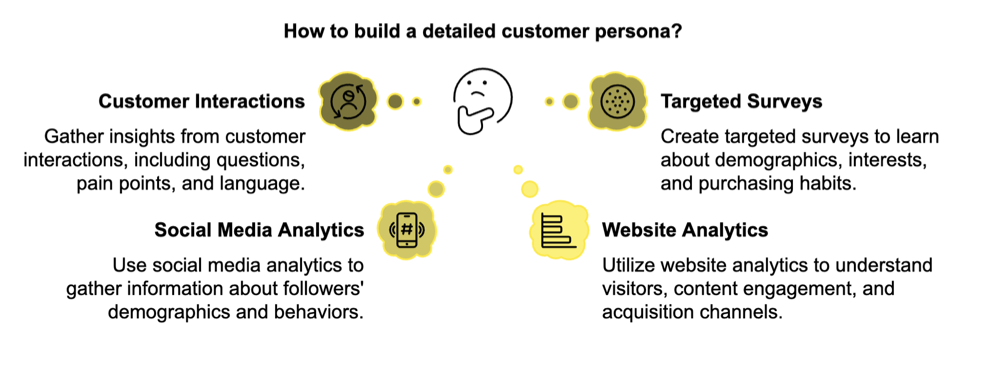
Armed with this information, you can create a detailed customer persona. Here’s an example:
Meet Sarah, the Busy Professional:
- Age: 35
- Occupation: Marketing Manager
- Income: $85,000/year
- Location: Urban area
- Interests: Fitness, healthy eating, professional development
- Pain Points: Limited time, work-life balance, staying up-to-date with industry trends
- Purchasing Habits: Researches extensively before buying, values quality and convenience
- Preferred Communication Channels: Email, LinkedIn
Creating this detailed persona allows you to tailor your marketing messages, product offerings, and communication strategies to resonate with Sarah and others like her. But don’t stop at one persona. Most businesses have multiple ideal customer types. Create 2-3 personas to represent your core customer segments. This allows you to craft targeted marketing campaigns that speak directly to each group’s unique needs and preferences. These personas aren’t set in stone. With the growth of your business and shifts in market conditions, it’s essential to revisit and refine your personas consistently. This ensures your marketing efforts remain relevant and effective.
Crafting Your Unique Value Proposition (UVP)
Now that you know who your ideal customers are, it’s time to communicate why they should choose you over your competitors. This is where your Unique Value Proposition (UVP) comes into play. Your UVP is the heart of your brand’s identity. It’s a clear statement that describes the benefit of your offer, how you solve your customer’s needs, and what distinguishes you from the competition. A strong UVP is clear and concise, communicates specific results, explains how you’re different, and can be read and understood in about 5 seconds.
Let’s break down the process of crafting your UVP:
- Identify Your Target Market: Use the insights from your customer personas to ensure your UVP speaks directly to your ideal customers.
- Explain the Problem You Solve: Be specific about the challenge your customers face.
- List the Key Benefits: Focus on the outcomes your customers will experience.
- Define What Makes You Unique: This is your “secret sauce.” What do you offer that your competitors don’t?
- Combine and Refine: Bring all these elements together into a clear, compelling statement.
Here’s a formula you can use: For [target market], [your company name] provides [key benefit] by [how you do it uniquely].
Let’s look at an example: “For busy professionals who value their time and health, FitMeal delivers chef-prepared, personalized meals straight to your door, using locally-sourced ingredients and AI-powered nutrition planning.”
This UVP clearly identifies the target market (busy professionals), the key benefit (convenient, healthy meals), and what makes the service unique (personalized, locally-sourced, AI-powered).
Once you’ve crafted your UVP, test it with some of your ideal customers. Does it resonate with them? Does it accurately reflect what your business offers? Refine it based on their feedback.
Implementing Your UVP and Differentiating Your Brand
Your UVP shouldn’t just live on your website’s homepage. It should inform all aspects of your marketing and branding. Feature your UVP prominently on your homepage and about page. Use it to guide your site’s content and design. Reflect your UVP in your social media bios and the content you share. Ensure your UVP is reflected in your brochures, business cards, and other marketing collateral. Use your UVP as a guidepost when developing new products or services. Train your team to embody your UVP in every customer interaction. Center your ad copy around your UVP to create consistent, compelling messages.
While your UVP is a crucial part of brand differentiation, there are other strategies you can employ to stand out in a crowded market. Develop a distinctive brand personality with a unique voice and visual identity that reflects your UVP and resonates with your ideal customers. Create a memorable customer experience that aligns with your brand values and UVP. Continuously innovate and improve your products or services based on customer feedback and market trends. Position yourself as a thought leader in your field through content marketing, speaking engagements, or industry collaborations. Align your brand with causes that matter to your ideal customers and reflect your company values through corporate social responsibility initiatives. Remember, differentiation isn’t just about being different—it’s about being meaningfully different in ways that matter to your customers.
To ensure your UVP and differentiation strategies are effective, you need to measure their impact. Here are some key metrics to track:
|
Metric |
Description |
|
Brand Awareness |
Use surveys or social media listening tools to gauge familiarity with your brand |
|
Customer Acquisition Cost (CAC) |
Should decrease over time if UVP is effective |
|
Customer Lifetime Value (CLV) |
Should increase with a strong brand and clear UVP |
|
Net Promoter Score (NPS) |
Measures likelihood of customers recommending your brand |
|
Conversion Rates |
Monitor impact of UVP across different marketing channels |
|
Market Share |
Track to see if differentiation strategies are gaining ground on competitors |
Regularly analyzing these metrics allows you to refine your UVP and differentiation strategies, ensuring they resonate with your ideal customers and drive business growth.
Moving forward with your marketing efforts, keep your ideal customer personas and UVP at the forefront of your mind. They’ll serve as your North Star, guiding your decisions and helping you create marketing messages that truly connect with your target audience. In the next chapter, we’ll explore how to develop a consistent and engaging brand voice that brings your UVP to life across all your marketing channels. You’ll learn how to create a brand personality that resonates with your ideal customers and sets you apart from the competition.